AI-generated Illustration

Capacitive keys

modern and intuitive

Capacitive keys and keyboards are the modern alternative to mechanical switches or membrane switches. They can be freely designed and, thanks to their completely closed surface, are virtually wear-free and hygienic. Operation is similar to that of a capacitive touchscreen – a single touch is enough. Capacitive fields can be implemented as buttons, sliders, or wheels.

Hoffmann + Krippner has been an experienced manufacturer of custom input systems for a wide range of applications for over 50 years. At our production site in Buchen in the Odenwald region, we develop and manufacture custom capacitive control elements.

Send request
Compact capacitive keypad with nine symbol keys and a connection lead

How a membrane switch
of capacitive keys

Capacitive keys and keyboards are touch-sensitive electrical fields (sensors) with no mechanical components. When a finger touches the sensor, charge is removed from the electric field. The electronics recognize this change in charge, deduce the exact point of contact and trigger the desired function.

User interface: The completely closed surface made of glass, Plexiglas, or polyester is custom-printed using screen printing and protects the sensor surfaces underneath.

Sensor foil or printed circuit board: The capacitive fields are printed onto a flexible polyester foil using a conductive, transparent paste. Alternatively, capacitive sensors can also be realized on a printed circuit board.

Exploded view of a capacitive keypad with a decorative overlay, sensor film and connection lead

Your capacitive keyboard. Your scope of performance.

From a simple sensor foil to a fully integrated HMI solution:
you decide which functions and components your application needs.
We combine the right technologies and, on request, also handle the integration.

1. The basis of your capacitive keyboard

  • Cover Glass or Foil

    Glass, acrylic glass, or polyester film with custom thicknesses, properties, or finishes.

  • Sensor foil or printed circuit board

    Space-saving and flexible as a sensor foil, or robust with complex electronics on a printed circuit board.

  • Connection options

    Sensor foil with customizable flat ribbon cable featuring ZIF, Crimpflex, and Duflex connectors, or a custom connection on a printed circuit board.

2. Expand your capacitive keyboard
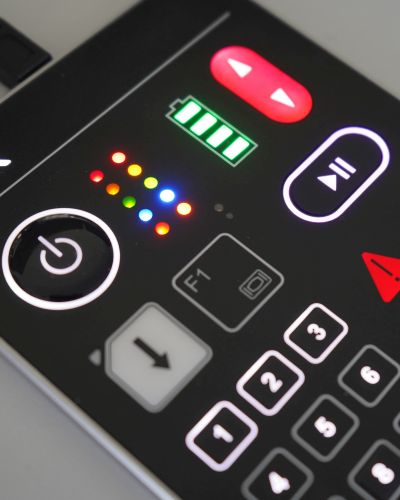
Membrane switch with illuminated keys, coloured status indicators and directional buttons

Lighting

Capacitive keys can be individually illuminated, providing optimal user guidance. The LED technology is integrated together with the evaluation electronics on a separate circuit board. For capacitive sensor fields on a printed circuit board, the LEDs are integrated directly on the sensor board.
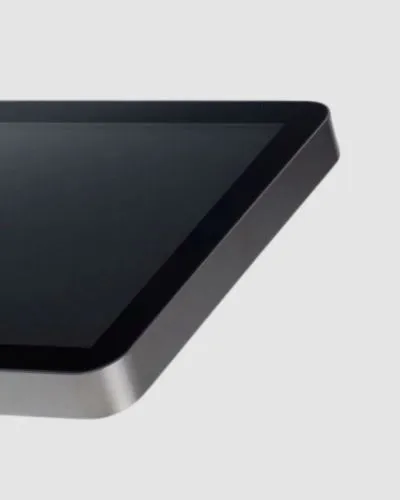
Detail der abgerundeten Ecke eines schwarzen Touchdisplays im Gehäuse

Touchscreen + display

Capacitive keys are an ideal complement to touchscreens and displays. Frequently used or safety-relevant functions can always be found quickly and operated conveniently. The connection to the touchscreen or display is made using an adhesive frame or full-surface OCA or LOCA bonding, resulting in a high-quality, closed design.
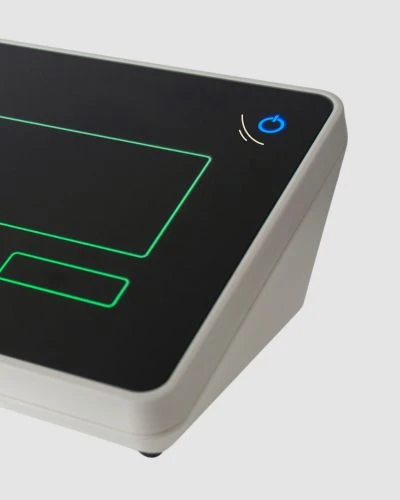
Close-up of a control unit with an illuminated capacitive button and green control markings

Key feedback

By default, touch-sensitive capacitive keys do not provide direct tactile feedback. However, optical, acoustic, or haptic signals (vibration) can be integrated to confirm an input. This gives the user clear feedback that the action was successfully performed.
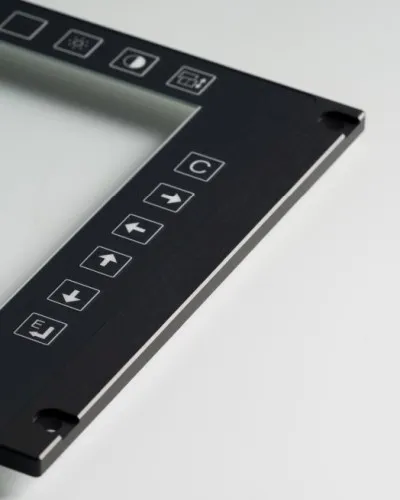
Folientastatur auf einem schwarzen Trägerteil mit seitlichen Befestigungslaschen

Housing + carrier

Capacitive keys can be mounted on custom carrier plates or integrated directly into housings. This results in robust, ready-to-install control units that can be easily integrated into the application.
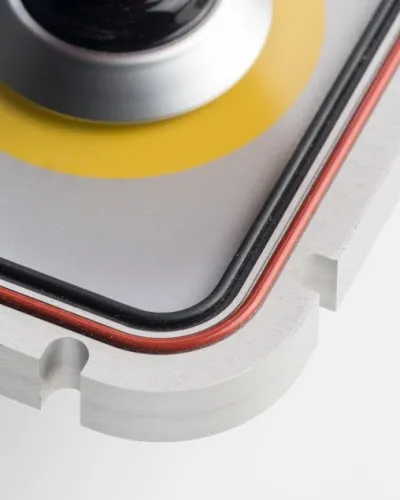
Nahaufnahme einer umlaufenden Dichtung zwischen Frontplatte und Gehäuse einer Bedieneinheit

Seals

For outdoor use, custom protection and sealing concepts can shield capacitive keyboards from dirt or water.

3. Complete solution tailored to your requirements

You receive a 360° worry-free package: one solution, one point of contact!
We take care of the time-consuming coordination of many individual components and services for you.
You define the scope!

Operating unit

Buttons, touch, printed electronics, or a combination of multiple technologies.

Housing

Standard housing or a custom housing solution made of plastic or metal

Electronics

Custom-populated PCBs and LED technology for button backlighting.

Software

Intelligent user guidance or protocols for smooth data transmission

Connectivity

Custom interfaces and IoT connectivity for value-added HMIs

Control unit in a light-coloured housing with a display and side-mounted capacitive buttons

Design + Development

Quality + Sustainability

Typical applications for
capacitive keys and keyboards

Medical technology & laboratory equipment:

Closed, disinfectable user interface for medical devices

Household technology & white goods:

Household appliances with flush-mounted, easy-to-clean controls

Mobility:

Modern capacitive keys replace mechanical buttons in vehicles

Building technology:

Access controls or smart home control panels with illuminated capacitive keys

Finger touching an integrated capacitive control on a dark worktop AI-generated Illustration

Individual solutions from Hoffmann + Krippner

Every project requires a precisely coordinated solution. We develop control units and sensor foils that are optimally suited to your application in terms of function, design and robustness – from technology selection to series production.

All services at a glance
Blick – download PDF here!

Graphic box elements for Hoffmann + Krippner

FAQ: Frequently asked questions about capacitive keyboards

The operability of capacitive sensors with gloves depends on the material and thickness of the gloves. Conductive gloves or a
increased sensor sensitivity are often required. Moisture from rain or perspiration can lead to malfunctions if no
special algorithms can be used. Modern systems use humidity compensation and adaptive sensitivity adjustment,
to ensure stable operation even under such conditions. This is particularly relevant for outdoor and medical applications.

Yes, capacitive buttons can be integrated behind robust materials such as glass or plastic. This creates a closed system,
Wear-free and resistant surface against dirt, moisture and cleaning agents.

Design, colors, lighting, symbols and even the operating feel can be individually adapted to the area of application. One
Glass surfaces can also be optically enhanced with cuts for finger recesses, polishing or etching, for example.

Capacitive buttons are designed for clearly defined switching functions and replace classic mechanical buttons. You react to
touch, but have fixed operating points. A touchscreen, on the other hand, is a dynamic input surface on which content can be displayed and
different functions can be displayed flexibly. Capacitive buttons are particularly suitable for robust, long-lasting
Operating concepts with clear user guidance, while touchscreens offer more interaction options

Kapazitive Tasten oder Folientastatur
– welche Technologie passt zu
my project?

Capacitive keys are ideal for modern, flush-mounted designs with wear-free operation.

Membrane switches are the right choice for clearly defined pressure points and tactile feedback in rugged applications.

Start your project!

New development or redesign?
We are your partner from prototype to series production.