
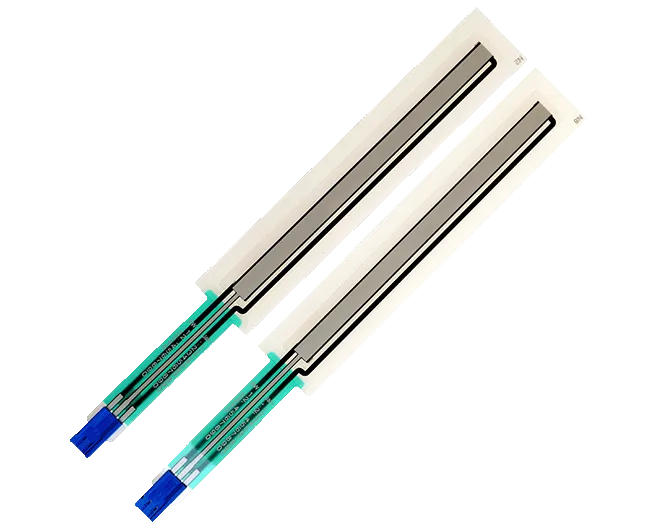
Functionality and structure of
Foil potentiometer
A membrane potentiometer consists of several layers that are combined into a sandwich structure. The membrane structure integrates the printed resistor track on a flexible carrier material, a spacer, and a collector film. By applying mechanical pressure to the collector film with a wiper or finger, the electrical resistance is changed depending on its position, generating an analog measured value. The entire electrical function is located inside the potentiometer and is protected from dust or liquids.
Collector film: The top film layer contains the collector track. For this purpose, a low-resistance layer is screen-printed on the inside.
Spacer: The spacer keeps the collector film and base film separated from each other when at rest. This keeps the circuit open.
Base film: This layer consists of a polyester film that is screen-printed with the resistor track.
Adhesive: The final adhesive layer enables easy and secure integration of the membrane potentiometer into the customer application. Optionally, we also supply the potentiometer pre-assembled on a carrier plate or already integrated into a housing.
Membrane potentiometers in
various designs
Your membrane potentiometers. Your scope of performance.
From a simple membrane potentiometer to an integrated solution:
Sie bestimmen, welche Funktionen und Komponenten Ihre Anwendung benötigt.
We combine the right technologies and, on request, also handle the integration.
1. The basis of your membrane potentiometer
-
Foil potentiometer
Sandwich construction with base film, spacer, collector film, and adhesive.
-
Connection options
Custom ribbon cable with ZIF, Crimpflex, and Duflex connectors or other contact options.
2. Expand your membrane potentiometer
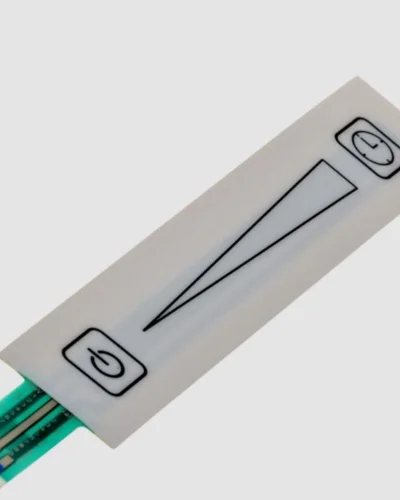
Design Foil
A custom graphic overlay provides the membrane potentiometer with an attractive user interface. The layout is applied to a polyester film using digital or screen printing.
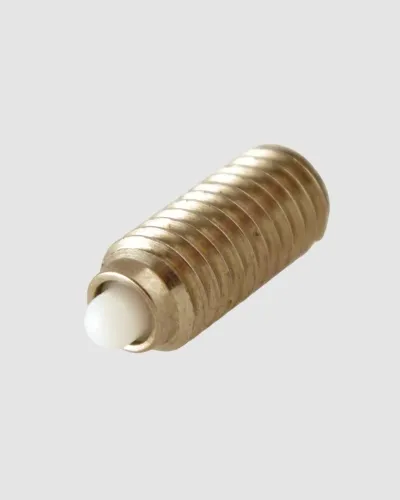
Wiper
For signal generation of our potentiometers, a suitable wiper can be used in addition to finger actuation. For membrane potentiometers with PET surface we recommend wipers with a plastic head.
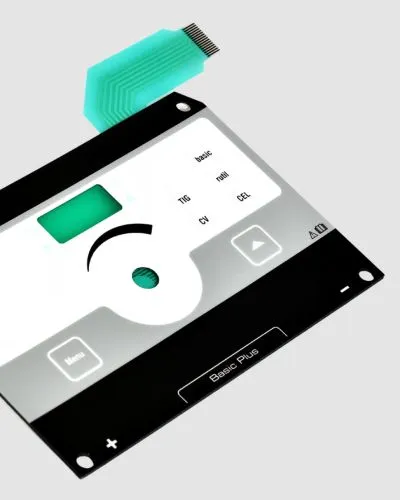
Membrane switch
Since the membrane potentiometer already consists of several film layers, it can be ideally integrated into membrane switches. Here, a potentiometer can function as a slider, for example.
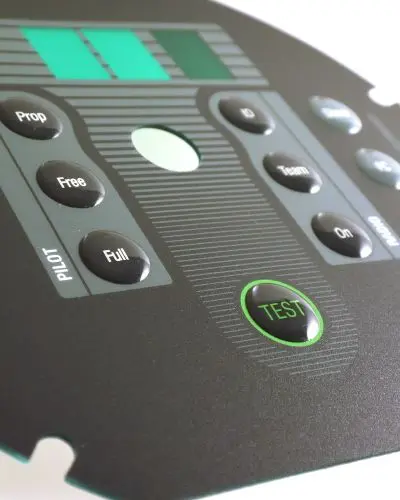
Embossing + doming
Custom embossing or doming offers optimal finger guidance and even enables blind operation. The raised areas can be individually designed and can be up to X mm high.
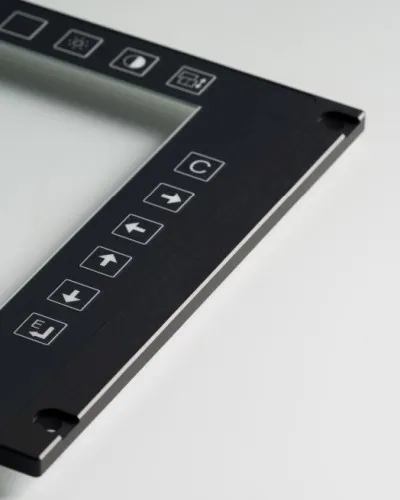
Housing + carrier
For more stability, a membrane potentiometer can be mounted on a custom support part or housing, which also simplifies installation into the customer application.
3. Complete solution tailored to your requirements
You receive a 360° worry-free package: one solution, one point of contact!
We take care of the time-consuming coordination of many individual components and services for you.
You define the scope!
Operating unit
Buttons, touch, printed electronics, or a combination of multiple technologies.
Housing
Standard housing or a custom housing solution made of plastic or metal
Electronics
Custom-populated PCBs and LED technology for button backlighting.
Software
Intelligent user guidance or protocols for smooth data transmission
Connectivity
Custom interfaces and IoT connectivity for value-added HMIs
Design + Development
Quality + Sustainability
Typical applications for membrane potentiometers
Medical technology:
Position sensors with linear travel measurement for infusion pumps
Mechanical engineering:
Travel or position measurement of diverse machine components
Mobility:
Reliable measurement technology for vehicle safety and crash tests
Rehabilitation technology:
Sensors for movement analysis or for rehab equipment
Technical data for membrane potentiometers
All technical data may vary depending on the customer-specific design.
Design
Linear
Overall height
from 0.5 mm
Lengths
up to 900 mm
Widths
from 10 mm
Resistance tolerance
+/- 30%
Independent linearity tolerance according to DIN ISO 2768 medium
2%
max. Wiper current in case of failure
0.1 A
Recommended wiper current during operation
0.1 µA
Operating voltage
1–42 VDC
Service life
1 million cycles
IP protection class
from IP54
Operating temperature
-25°C to +55°C
FAQ:
Frequently asked questions about membrane potentiometers
Membrane switches offer a high degree of customization. Size, shape, print, surfaces, lighting, connection options can be
can be freely customized. Transparent windows for displays, integrated LEDs or embossed key surfaces are also possible. So
creates an input system that fits perfectly into the design and functionality of your product.
Design:
The top layer of the membrane switch, the front foil, is screen printed. A wide range of RAL-classic colors is available for this purpose,
Pantone or HKS to choose from. Special colors according to the customer CI, a disappearing effect or a metal look with reflection are possible.
also possible.
Mechanics:
The size and shape of the membrane switch is fully adapted to the design of the device. Button sizes and positions, installation and
Fastening options and even tolerance specifications can be customized.
Electronics:
In addition to the snap domes for the buttons, LEDs can also be integrated for individual lighting. The circuit diagram and the
Connection (cable, plug, number of poles) of the membrane switch can also be customized. An integrated electronics assembly on a
Printed circuit board is possible.
Haptics:
In addition to different surface textures on the front foil, additional embossing (surfaces, frames, symbols) or GT domes can also be added to the front foil.
Improve user-friendliness.
Membrane switches consist of several resistant polyester layers. Depending on the structure and material, they achieve several
million actuation cycles per button. The closed surface provides reliable protection against mechanical wear, dust and dirt and
ensures constant functionality over many years.
Yes, membrane switches are particularly resistant to environmental influences due to their closed surface. Depending on
The products can be manufactured to protection classes such as IP65 or higher and are therefore resistant to dust and moisture. The used
Polyester films are also resistant to many cleaning agents and disinfectants. Membrane switches are therefore also suitable for
Ideal for hygienic environments, such as food or medical technology.
Yes, membrane switches can be designed to work reliably outdoors. UV-resistant
and temperature-resistant materials are used. In addition, protection types and temperature suitability can be individually adapted so that
the keyboards remain reliably functional at operating temperatures of – 40 °C to 70 °C. Sufficient edge bonding, special
Adhesives or additional seals make a membrane switch ready for outdoor use.
GT technology is a process developed by Hoffmann + Krippner to produce a dome-shaped, high-gloss plastic material with a high gloss finish.
onto a film surface. GT stands for casting technology. The GT domes are mainly applied to key surfaces,
to improve tactility and enable optimum finger guidance (for blind operation). The plastic mass is extremely
Resistant to mechanical influences. Pressure marks caused by hard objects can “heal” without leaving any residue.
Hoffmann + Krippner has been developing and producing customized membrane switches “Made in Germany” for decades. Customers benefit
from a unique combination of many years of experience, state-of-the-art production technology and individual advice. Every keyboard
is precisely tailored to the requirements of the application – from design and feel to material selection and special protection and
Hygiene functions. Thanks to our in-house development and production expertise, we can guarantee the highest quality, short distances and
guarantee reliable series production.
Start your project!
New development or redesign?
We are your partner from prototype to series production.