

Your HMI solution. Your scope of performance.
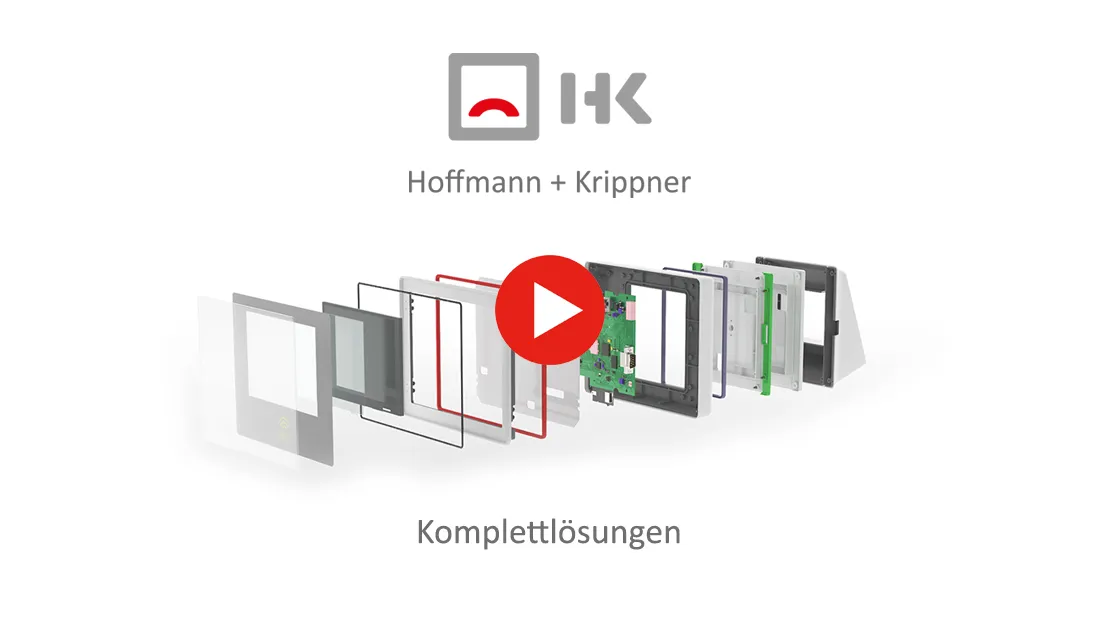
You receive a 360° all-in-one package: one solution, one point of contact!
We take over the time-consuming coordination of many individual components and services for you. From product development to series delivery, you receive everything from a single source. Assemble the perfect complete solution for your application from our modules. You determine the scope!
Operating unit
Buttons, touch, printed electronics, or a combination of multiple technologies.
Housing
Standard housing or a custom housing solution made of plastic or metal
Electronics
Custom-populated PCBs and LED technology for button backlighting.
Software
Intelligent user guidance or protocols for smooth data transmission
Connectivity
Custom interfaces and IoT connectivity for value-added HMIs

Design + Development
Quality + Sustainability
More possibilities together
Five companies pool their core competencies within the HK.SYSTEMS group of companies. Together, we combine our know-how for complex operating units, electronics, digitalization, and IoT, and develop customized solutions for demanding applications.
Through close cooperation within the group of companies, classic HMI solutions can be expanded with digital functions. Machine data becomes usable and creates the basis for new services and business models: from predictive maintenance and automated reordering of consumables to pay-per-use models. This results in holistic solutions that combine technical requirements with digital possibilities and create long-term added value for our customers.
Learn more about digital business models and IoT solutions from our sister company HK.DIGITAL.
Typical areas of application for HMI solutions
Medical technology:
Hybrid HMI solutions with touchscreen and haptic keys for secure input
High-end mechanical engineering:
Extensive functions clearly designed in one HMI solution
Mobility:
Robust and intuitive HMIs that withstand vibrations and shocks
Food industry:
HMI solutions protected up to IP69K for demanding hygiene requirements

The path to the perfect HMI solution
Every application is different – and that is exactly our strength. Our structured development process ensures that your requirements are implemented efficiently.
Requirement + Concept
We understand your product, the end user, and
challenges.
Workshop
Briefing
Functional and technical specifications
Sketches
Mechanics + Design
We align your requirements
with the technical possibilities.
2D data
3D CAD data
Renderings
Electronics + Software
We develop the
electronics unit and
communication solution.
Bills of materials
Circuit diagrams
Software protocol
Prototyping + Samples
We turn your idea into
reality and test
function and quality.
Experimental setup
1 – 10 functional samples
Fixtures
Initial sample test report
Series production
We ensure reliable and
repro-
ducible results in series production.
Toolmaking

FAQ: Frequently asked questions about HMI complete solutions
A human-machine interface (HMI) refers to any form of user interface via which a person can interact with a machine, device
or a technical system. It is used to capture inputs and display feedback from the system in an understandable way.
HMIs can have a very simple design – with individual buttons or status LEDs, for example – or complex systems with touchscreens, displays,
tactile controls and integrated electronics. They form the communicative level between people and technology.
An HMI solution (human-machine interface) is made up of several coordinated components. Depending on
the application and industry, these can vary. An HMI solution typically comprises the following components:
Control elements
These include buttons, touch surfaces, membrane switches, keypads, rotary encoders or combined input systems via which the user can interact with the
machine or device.
Display and visualization elements
Displays, LEDs, illuminated fields or symbols for displaying statuses, measured values and process information.
Electronics and control
Printed circuit boards, controllers and interfaces for signal processing, communication and connection to the higher-level control system or the
system.
Mechanics and housing
Front panels, carriers, seals and housing solutions that ensure protection, stability and secure integration into the overall device.
Surface design and labeling
Layout, symbols, colors and haptic elements that support usability, ergonomics and recognition.
Software and system integration (optional)
Depending on the project, the HMI solution may also include firmware, drivers or support with system integration.
The main challenges in HMI projects are complex system integration, dynamic user requirements, and
ensuring long-term maintainability. The integration of different hardware and software components requires specialized know-how. It is also crucial to identify user expectations at an early stage in order to ensure acceptance. The entire life cycle also requires forward-looking planning of updates and upgrades.
A customized HMI solution is recommended when standard products do not meet specific requirements in terms of functionality, design, or
environmental conditions. This applies in particular to applications in extreme operating environments, where
brand integration or complex workflows are required. A tailored solution also offers
advantages when connecting proprietary legacy systems, as it can be optimally adapted to the intended use and future expansions.
Sustainability in HMIs depends on the choice of materials, energy efficiency and recyclability. Recyclable or biodegradable
materials reduce the ecological footprint. Optimized energy use during operation and modular construction methods for
extending service life also improve the environmental footprint.
Start your project!
New development or redesign?
We are your partner from prototype to series production.