
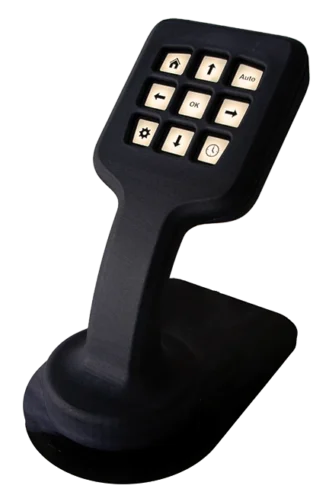
The user interface
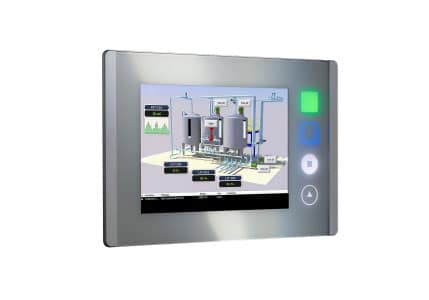
The completely closed surface made of glass, Plexiglas or polyester protects the input system from dirt and liquids. The front can be designed entirely according to customer requirements using screen and digital printing. Specially processed surfaces make capacitive operating elements particularly resistant and create optimum conditions even for harsh areas of application.
Capacitive keyboards
- are available on a foil basis(capacitive sensor foil) or printed circuit board
- can be realized as buttons, sliders or wheels
- can be illuminated
- are robust and resistant
Advantages:
- Fully closed surface
- Millions of actuations with consistent triggering characteristics
- Hardly any wear and tear
- Simple and intuitive operation
- Ideal for input systems at risk from vandalism
- Ideal for visually demanding applications
More information about capacitive keyboards in the Induux Wiki.

Components and options
Tactile, sustainable capacitive keys
Tactile Key is a sustainable operating concept that avoids unnecessary waste while bringing new features to capacitive keys. Capacitive keys become tactile due to the special design. Key shapes can be raised or recessed and individually illuminated.
The simplified system design also allows easy disassembly of the electronics from the front panel. Individual assemblies can now be repaired, replaced and also recycled. Previously bonded superstructures were difficult or impossible to repair. The direct contact of the capacitive sensor with the operating surface ensures high sensitivity and enables integration even behind 3D deformed surfaces.
LEDs for the illumination of the sensor fields can also be easily integrated on the PCB. You do not need a separate electronics unit.
Special features of Tactile Key:
- Blind operation possible
- High sensitivity
- 3D deformed surfaces in combination with illuminated keys
- Deformed plastic panels can be operating surface at the same time
- Electronics dismountable and recyclable
- Parts and cost saving
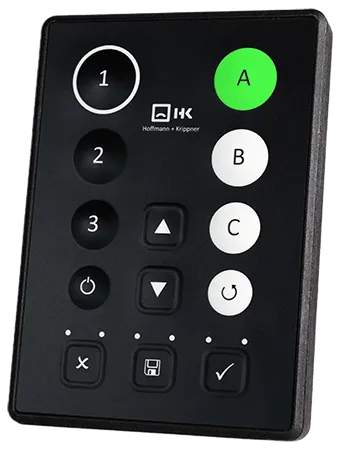
Capacitive keys on film
Capacitive sensor fields for keys, sliders or wheels can be printed on polyester films using conductive pastes. Polyester films have the advantage that they are light and flexible and can also be applied to curved substrates. The use of capacitive keys on curved fronts, such as washing machine panels, is possible without any problems.
Learn more about capacitive sensor films.
In-Mold Electronics
In the in-mold process, the capacitive film is seamlessly combined with a plastic housing. Instead of laminating the film onto a housing with transitions and gaps, the injection molding process directly back-molds the capacitive film. Two assemblies are combined into one.
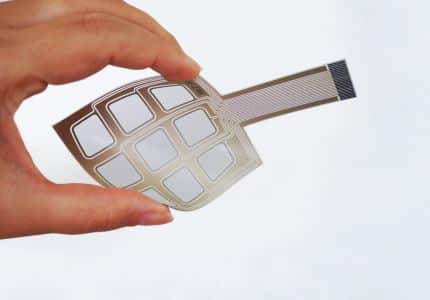
Capacitive keys on printed circuit boards
Capacitive sensor fields on printed circuit boards offer the advantage of integrating further electronic components and the evaluation electronics on the same board. The direct proximity of the evaluation electronics makes the system less susceptible to interference.
LEDs for the illumination of the sensor fields can also be easily integrated on the PCB. You do not need a separate electronics unit.
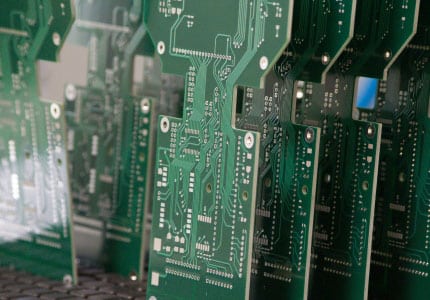
Illuminated capacitive keys
A capacitive operating unit can even be used in unfavorable lighting conditions. Diverse LED colors light up all relevant areas brightly. Our innovative SideLED technology provides homogeneous illumination while saving space.
Capacitive film sensors can even be transilluminated thanks to highly transparent pastes.
FAQ: Frequently asked questions about capacitive keyboards
The operability of capacitive sensors with gloves depends on the material and thickness of the gloves. Conductive gloves or a
increased sensor sensitivity are often required. Moisture from rain or perspiration can lead to malfunctions if no
special algorithms can be used. Modern systems use humidity compensation and adaptive sensitivity adjustment,
to ensure stable operation even under such conditions. This is particularly relevant for outdoor and medical applications.
Yes, capacitive buttons can be integrated behind robust materials such as glass or plastic. This creates a closed system,
Wear-free and resistant surface against dirt, moisture and cleaning agents.
Design, colors, lighting, symbols and even the operating feel can be individually adapted to the area of application. One
Glass surfaces can also be optically enhanced with cuts for finger recesses, polishing or etching, for example.
Capacitive buttons are designed for clearly defined switching functions and replace classic mechanical buttons. You react to
touch, but have fixed operating points. A touchscreen, on the other hand, is a dynamic input surface on which content can be displayed and
different functions can be displayed flexibly. Capacitive buttons are particularly suitable for robust, long-lasting
Operating concepts with clear user guidance, while touchscreens offer more interaction options
Start your project!
New development or redesign?
We are your partner from prototype to series production.