
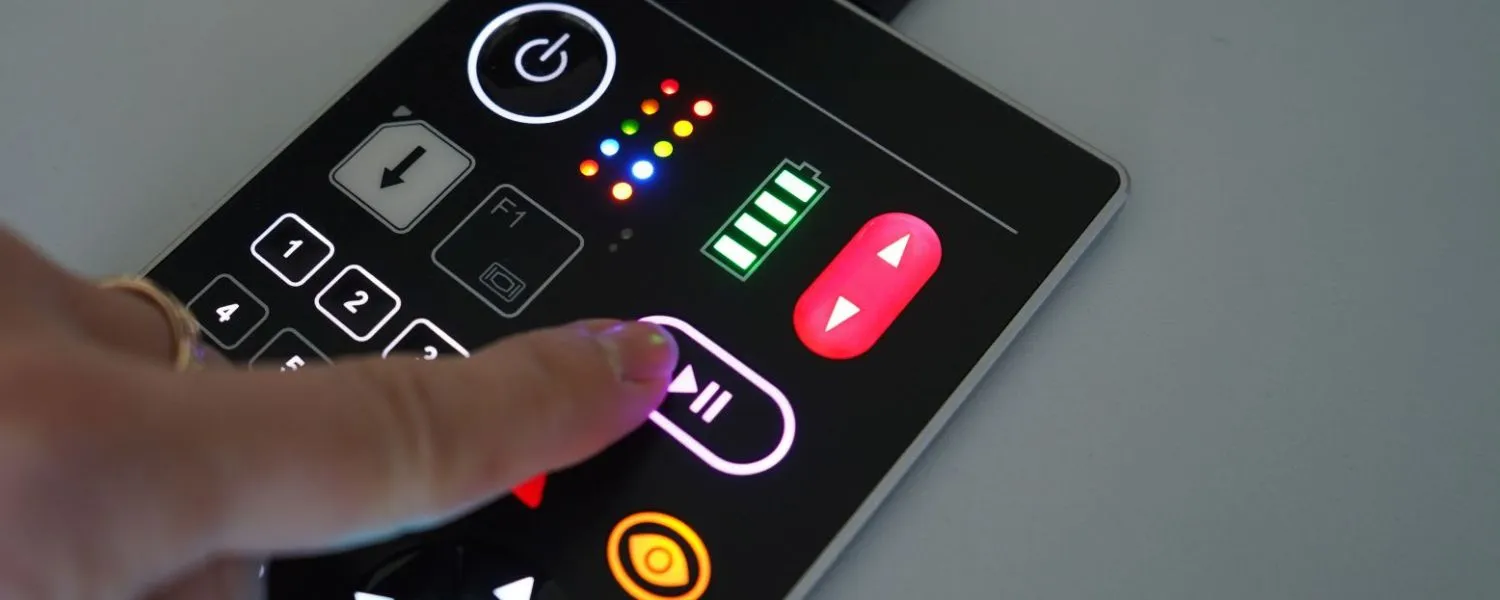
Illuminated membrane switches reduce operating errors, enable intelligent user guidance and offer safe interaction, even in demanding areas of application. In many devices and machines, operation is not tied to ideal lighting conditions. Dark working environments or mobile applications outdoors place high demands on the readability and operability of operating units. At the same time, membrane switches with lighting raise questions about technology, costs and design freedom during development, which should be considered at an early stage.
What are illuminated membrane switches?
Illuminated membrane switches are membrane switches in which keys, symbols or displays are actively or passively illuminated. The lighting is not just for visual enhancement, but primarily fulfills functional purposes such as orientation, status display or error minimization.
Depending on the design, the lighting can:
- Highlight individual buttons
- Illuminate complete keypads
- Make symbols, labels or icons visible
- Signaling states or functions
This makes illuminated membrane switches a combination of input and display element.
Lighting technologies at a glance
Various technical concepts are available for implementation, each of which has specific advantages and disadvantages. The most commonly used solutions today are

Membrane switches with SideLEDs
- LEDs shine in from the side
- Homogeneous surface illumination of buttons and symbols
- Low installation depth (keyboard design from 1.2 mm)
- Placement on foil or printed circuit board
- Integrated scattering element
- Light partitioning depending on design
Membrane switches with TopLEDs
- LEDs shine in from below
- Rather punctual illumination
- With special keypad design and light guide, surface illumination is also possible to a limited extent (greater installation depth required)
- Placement on foil or printed circuit board
To select the right LED technology, we consider the available installation space, the desired functions and possible environmental influences on the control unit. This applies to both:
variable Helligkeitsstufen
Homogeneous illumination
Good energy efficiency
Large selection of colors
Disappearance effect
When should LEDs be mounted on a printed circuit board (PCB) instead of a foil?
Illuminated membrane switches on printed circuit boards are useful when robustness, performance and complexity are paramount. Typical requirements are
- Strong illumination required: The PCB enables better heat dissipation, more stable control and the use of more powerful LEDs
- Complex or dynamic lighting: This requires more complex control electronics (e.g. drivers, controllers), which are ideally mounted on a printed circuit board.
- Membrane switches are exposed to vibrations: LEDs mounted on foil are not yet comparable with the stability of SMD-mounted LEDs on a printed circuit board.
Design and layout options
Membrane switches with lighting offer much more design freedom than you might think at first glance:
- Illumination of individual buttons or symbols
- Multicolored lighting for status display or user guidance
- Combination of lighting and embossing and/or GT technology
- Integration of a disappearing effect: only active buttons are illuminated
- Adaptation to corporate design or product lines
Especially when redesigning existing devices, the operating quality can be significantly improved without completely changing the basic concept.
Important selection and decision criteria
To ensure that an illuminated membrane switch works reliably in the long term, the following points should be considered at an early stage:
- Brightness and contrast in the real environment
- Energy requirement and control
- Service life of the lighting
- Environmental influences (temperature, humidity, chemicals)
- Standards and approvals
- Costs over the entire product life cycle
A common mistake is to consider lighting late in the development process. This can lead to unnecessary additional costs, design compromises or technical restrictions.

Typical areas of application for illuminated membrane switches
Illuminated membrane switches are used wherever operation needs to be safe, intuitive and error-free:
- Mechanical and plant engineering: In production halls with inconsistent lighting or changing lighting conditions (shift operation)
- Medical technology and laboratory equipment: For diffuse ambient light during examinations or procedures or to highlight key functions and warnings
- Mobile devices and vehicles: In strongly changing light conditions and for quick orientation without long searches
- Food and hygiene areas: For clear visibility with a surface that is easy to clean
- Building and security technology: for easy use by different groups of people and visual feedback
In addition to illuminated membrane switches, capacitive keys can also be illuminated without any problems.
Connection with classic membrane switches
Illuminated variants are technically based on classic membrane switches and add additional functions.
You can find a basic overview of the design, functionality and basic technologies on our page on membrane switches. It explains the basic principles on which illuminated versions are based.
Conclusion: Involve early, decide better
Illuminated membrane switches offer great potential for improving usability, especially for new developments, redesigns or changes to standard requirements.
Early coordination with an experienced development partner helps to realistically assess technical possibilities, control costs and avoid subsequent adjustments.
FAQ: Frequently asked questions about membrane switches
Yes, they are also suitable for outdoor use if appropriate design measures are implemented and materials selected.
The mechanical service life remains unchanged. The service life of the lighting depends on the technology used.
This is possible, but should be checked at an early stage, as the layout, layer structure and electronics must be adapted.
More information about illuminated membrane switches at Induux
Start your project!
New development or redesign?
We are your partner from prototype to series production.